Real-Time Grid Stress Intelligence
See when and where the power grid is under stress — before problems escalate.
Request AccessInfrastructure-Aware Grid Intelligence
A clear, explainable view of stress drivers across markets, infrastructure, and weather.
Infrastructure-Aware Grid Stress
Grid stress weighted by nearby generation assets and high-voltage transmission corridors.
Nodal Price Intelligence
Spatial price dispersion and nodal patterns used to detect congestion and market fragmentation.
Transmission Corridor Stress
Identification of stressed transmission corridors using nodal price gradients.
Generation & Fuel Context
Fuel-type and capacity context to understand flexibility and scarcity.
Weather-Driven Stress Signals
Integration of temperature extremes, storms, and weather anomalies tied to grid stress.
Persistence & Early Warning
Metrics that distinguish short-lived volatility from sustained system pressure.
Identifying Grid Stress
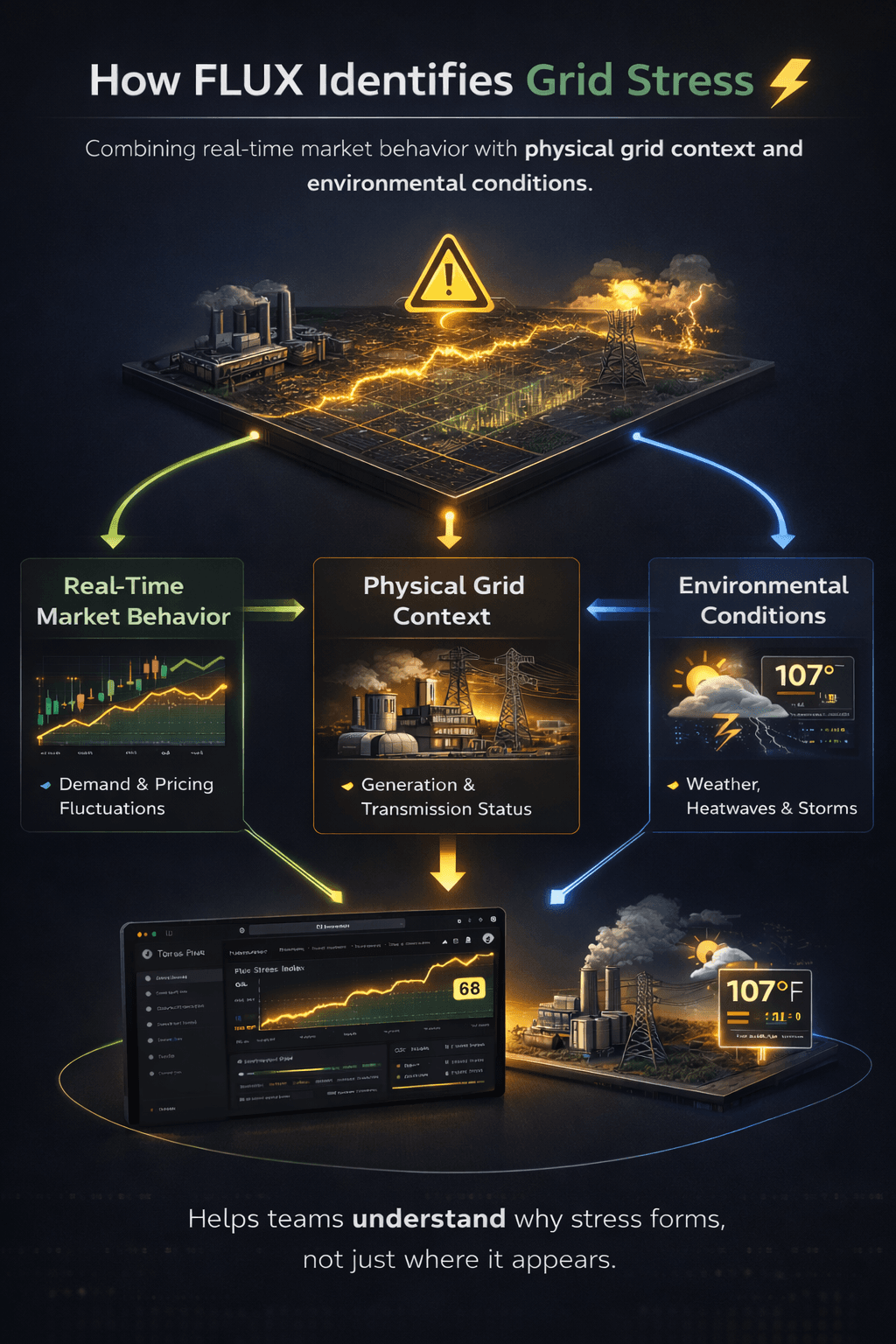
FLUX identifies grid stress by combining real-time market behavior with physical grid context (generation and transmission) and environmental conditions (weather). This helps teams understand why stress forms, not just where it appears.
The FLUX Stress Index
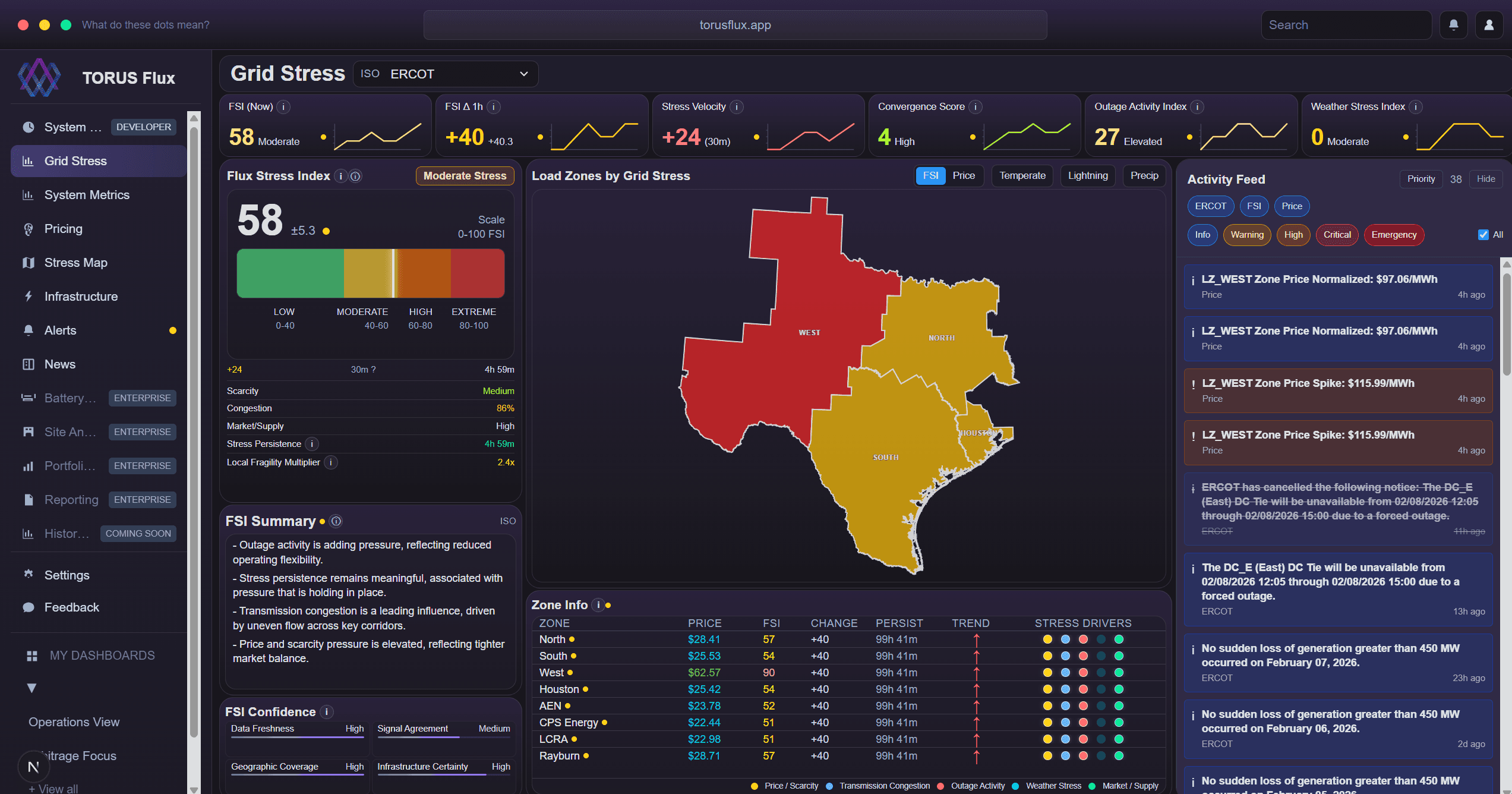
The FLUX Stress Index is a composite, infrastructure-aware measure designed for situational awareness and early warning. It combines real-time price behavior, congestion persistence, weather impacts, fuel mix conditions, and infrastructure-weighted stress signals into a single, interpretable score. The index reflects how tightly the grid is operating, not just price volatility.
Use Cases
Battery Storage Operators
Improve situational awareness and timing decisions as stress builds.
Energy Consultants
Provide explainable grid stress context for clients and stakeholders.
Renewable Developers
Identify emerging congestion risk for siting and interconnection planning.
Demand Response and Grid-Focused Teams
Detect early stress signals and coordinate operational readiness.
Data Center Siting
Evaluate grid resiliency signals before committing to new load.
Energy Traders
Monitor stress signals that shape market regimes and congestion risk.
Ready to see the grid differently?
Join our beta program and get early access to Grid Flux.